Realm Idle
- 4.5
- Rating
- 100.00K
- Installs
- Free
- Price

 Analysis by App-foxy
Realm Idle is the kind of role-playing game I open when I want progress without committing to a long session. Developed by AbyA, it puts the focus on building skills, defeating monsters, and gradually reaching tougher enemies. The basic appeal is simple: start a fight, improve your character, and return later to see how far your preparation carried you.
After spending time with it, I found that the game works best when treated as a routine rather than a conventional adventure. It is not trying to replace a story-heavy RPG, a tactical dungeon crawler, or a fast action game. Its satisfaction comes from small upgrades, sensible target choices, and the feeling that a short check-in can still move the account forward.
How I built a reliable daily routine
My usual starting point was to look at the current creature and ask a practical question: can my character defeat it consistently, or am I only winning often enough to make the fight feel exciting? That distinction matters in an idle RPG. A difficult enemy may offer better progress when defeated, but repeated failures or slow victories can make the overall session less useful than staying with a safer target.
You May Also Like

 AccuWeather: Weather Radar
AccuWeather Review: A Quick, Clear Forecast for Everyday Decisions
For everyday plans, the best forecast is the one you can understand quickly. AccuWeather makes rain timing, radar, and local conditions easy to act on, with a few trade-offs.

 Hill Climb Racing
Why Hill Climb Racing Still Turns Crashes Into One More Run
A tiny car, a bumpy hill and one more upgrade: Hill Climb Racing keeps resurfacing because its simple chaos makes every near-miss feel personal.

 AliExpress - Shopping App
AliExpress Makes Global Shopping Feel Personal, but Shoppers Bear the Risk
AliExpress turns a global marketplace into a pocket-sized discovery engine. Its reach is useful, its shopping loop compelling, and its trade-offs easy to miss.

 Lords Mobile: Kingdom Wars
Lords Mobile Is a Kingdom-Building Routine, Not a Quick Match
A case-by-case verdict on the building, battles, device demands, and social commitments that make Lords Mobile rewarding for some players and exhausting for others.

 PDF Scanner app - TapScanner
TapScanner Makes Paperwork Easier to Capture, Check, and Share
TapScanner makes scanning with a phone feel less like a rescue operation and more like a dependable step in getting work done. Its capture tools are useful, though not flawless.

 Block Blast!
 Shows How Much a Puzzle Game Can Leave Out
A quiet grid game shows why puzzle players increasingly value instant clarity, repeatable skill and low-pressure play—and where the genre still needs to catch up.
More From Our News Desk
View All News


I began each visit by checking the result of the previous farming choice. If the character had advanced comfortably, I moved upward. If progress had stalled, I returned to a creature that could be handled more reliably and used that period to strengthen skills. This sounds obvious, but it prevents a common mistake: choosing the strongest visible opponent instead of the strongest opponent that fits the current build.
The game’s skilling focus gives those decisions more weight than a simple “fight and collect” loop. I did not view every upgrade as equally valuable. When a particular improvement helped me clear a creature more steadily, it was usually more useful than spreading attention across several weaker gains. That made each return to the game feel like a small planning exercise rather than a button press.
For a realistic everyday example, I would start a longer farming period before making breakfast, check the result during a commute or break, and then change the target only if the previous choice had become inefficient. In the evening, I would spend the accumulated progress on improvements and set up the next stretch. The best habit is to make one informed adjustment, then leave the game alone long enough to work.
This approach also answers an important question for new players: do you need to watch constantly? In my experience, no. The game is more comfortable when you accept its gradual pace. Frequent checking can be useful while learning the limits of a build, but repeatedly reopening the game without a clear decision to make adds little. Realm Idle rewards a repeatable rhythm more than constant attention.
What I checked before chasing stronger monsters
I paid attention to three practical signals: how quickly fights were resolving, whether the current enemy was producing dependable progress, and whether a new skill improvement changed the outcome. These signals are more useful than simply looking at the enemy’s strength. A target that appears only slightly harder can still be a poor choice if it turns a stable farming cycle into a string of slow or failed attempts.
Another useful habit was separating experimentation from farming. When I wanted to test a stronger creature, I treated the attempt as a trial rather than immediately committing the whole session to it. If the result looked promising, I kept the target. If not, I went back to the previous option. This protects progress while still allowing the account to move forward.
That is one of the game’s quiet strengths. It leaves room for personal judgement without burying the player under a large amount of story, equipment management, or map navigation. The trade-off is that players who need constant variety may find the loop repetitive. I enjoyed the repetition when I had a clear reason for it, but it became less appealing when an upgrade did not noticeably change my next decision.
Settings and small habits that make the loop easier
Because this is an idle game, I recommend checking the available settings early instead of waiting until the routine is established. I looked for options that affected how comfortably I could leave the game running, how clearly progress was presented, and whether notifications or sound suited the way I wanted to play. These choices do not change the underlying combat, but they can make short sessions less distracting.
Sound is worth considering based on where you play. If I was checking progress in public or during a quiet break, I preferred a restrained setup rather than letting the game become noticeable. At home, audio can make the routine feel more active, but it is not essential to understanding the core loop. The game remains readable as a progress-focused experience even when I treat it almost like a background companion.
I also found it useful to keep the game’s role clear on my phone. Realm Idle is better suited to quick returns than to being left open as a full-time activity. If you are trying to preserve battery, reduce interruptions, or avoid unnecessary screen time, the sensible approach is to launch it for a decision, make the adjustment, and close it when there is nothing else to manage.
New players may wonder whether the game demands spending to make progress. It is free to play, with optional in-app purchases ranging from $0.99 to $24.99 per item. I would treat those purchases as convenience choices rather than part of the basic reason to try the game. The important test is whether the normal loop feels satisfying before spending anything. If the repeated creature battles already feel too slow, paying will not necessarily solve the deeper issue that the progression style may not suit you.
The age rating is Everyone 10+, which makes the presentation approachable for a broad audience. Even so, I would still recommend that younger players understand the purchase options before using the game, especially because several individual items can sit at very different price points. For adults, the main consideration is not complexity but patience: the game asks whether you enjoy gradual improvement more than immediate spectacle.
How I used progress checks instead of constant tapping
My most effective routine was built around checkpoints. I would note what I was trying to improve, choose a creature that tested that improvement, and return later to judge the result. This created a simple feedback loop: change one thing, observe the outcome, and avoid making several adjustments at once. When too many variables changed together, it became harder to tell which decision had actually helped.
This is particularly useful for experienced players who want a repeatable method. Rather than spending every visit browsing through possibilities, I used a short checklist: confirm the current target, review the latest skill progress, test whether the next creature was realistic, and stop once the next action was clear. That reduced aimless play and made the game fit naturally into spare moments.
A second habit was reserving some sessions for safe progress and others for testing. Safe sessions kept the account moving when I was busy. Testing sessions happened when I had time to compare outcomes and adjust my plan. This division is a small but meaningful improvement over treating every login as a push toward the hardest available opponent.
The game is also a better match for players who like asynchronous progress than for people who want a strong sense of control over every attack. In a traditional RPG, I might win by reacting to enemy patterns or selecting commands at the right moment. Here, the important decisions happen around preparation and target selection. That makes the game calmer, but it also means the moment-to-moment combat has less drama.
Faster patterns for players who understand the loop
Once I understood the baseline routine, I stopped asking, “What is the strongest enemy I can attempt?” and started asking, “What target gives me the best dependable next step?” That change in wording improved my decisions. It encouraged me to value consistency, because a reliable cycle creates more useful progress than an impressive enemy that repeatedly interrupts the flow.
One pattern I recommend is the near-threshold test. When a new creature seems within reach, try it briefly after an upgrade rather than switching immediately after every small gain. If the result is clearly better, keep it as the new farming target. If the improvement is marginal, return to the safer creature and wait for a more meaningful change. This avoids wasting time on constant target changes.
A second pattern is to group related choices. If I was focusing on a skill, I tried to let that goal guide both my target selection and my upgrade spending. That gave the session a purpose and made the results easier to judge. Randomly alternating between unrelated improvements may feel active, but it can delay the point at which any one change becomes strong enough to matter.
A third pattern is to use idle time deliberately. Before a period when I knew I would be unavailable, I chose stability over ambition. Before a period when I expected to check the game again soon, I was more willing to test a harder creature. This simple distinction made the game more compatible with real life. The right target depends not only on character strength but also on when you plan to return.
These habits are not flashy features, and they do not turn the game into a different genre. They simply make its central loop less wasteful. In a game built around repeated battles, small reductions in indecision add up. I found that the greatest improvement came from having a plan before leaving the game, not from spending more time inside it.
Where it differs from other role-playing choices
Compared with a story-driven mobile RPG, Realm Idle offers far less narrative motivation and fewer reasons to explore a world for its own sake. If you play mainly for characters, dialogue, cinematic battles, or a large map, another role-playing game will probably be more rewarding. This game is about the process of strengthening a character and pushing through progressively stronger creatures.
Compared with a traditional idle game that focuses almost entirely on automatic rewards, the skilling element gives me more to think about. I still spend much of my time waiting for progress, but the choice of what to improve and when to challenge the next creature creates a clearer sense of ownership. The downside is that the game can feel slower when an upgrade does not immediately unlock a new possibility.
It also differs from action RPGs in its relationship with attention. I could not rely on reflexes or complicated combat input to rescue a weak setup. Preparation mattered more than speed. That makes it suitable for short, interrupted sessions, but not ideal if you want a game that keeps your hands busy and rewards active performance every few seconds.
Advanced limits and the point where patience matters
The biggest limitation is repetition. The creature-grinding structure is deliberately narrow, and its appeal depends on whether you enjoy watching a character become more capable through many small steps. I was comfortable with that when each decision had a visible purpose. When progress felt like waiting for the next threshold without a meaningful choice, the experience became less engaging.
Another limitation is that idle progress can make improvement feel indirect. You may make the correct decision and still need time before the result becomes obvious. Players who prefer immediate feedback may interpret this as a lack of depth, while players who enjoy long-term routines may see it as the central pleasure. Neither reaction is wrong; the game simply puts more value on patience than on constant novelty.
I also would not recommend approaching every new creature as a mandatory milestone. Sometimes the efficient choice is to stay with a familiar opponent while building a stronger base. This can feel conservative, especially when the game presents a tougher challenge, but it protects the rhythm that makes idle progression worthwhile. The advanced skill is knowing when ambition is productive and when it is only slowing the account down.
For users considering purchases, I would set a personal rule before buying anything: spend only if the basic game already fits your routine and the item addresses a specific convenience you value. Do not use a purchase to force yourself to enjoy the format. Since the game is free to start, it is easy to test whether the combination of skilling, monster grinding, and waiting feels satisfying without making an early commitment.
Device requirements are also straightforward for many older phones: the game supports Android 7.0 and later. That makes it accessible to people who are not using a recent handset, although actual comfort will still depend on the phone and how you prefer to manage background play. On my side, the more important question was not raw hardware but whether the game fit naturally into my daily pattern of short check-ins.
The current version is 4.0.0.6, and the game has been available since January 29, 2026. Its audience is still modest compared with the largest mobile RPGs, with over 10 thousand installs, but the average rating is 4.6 from around 1.2 thousand ratings. I read that combination as a sign of a focused game with a receptive audience, not as proof that everyone will enjoy its deliberately repetitive structure.
Who should play, and who should skip it
I would recommend Realm Idle to someone who likes incremental progress, wants a role-playing game that can fit around work or study, and enjoys making small efficiency decisions. It is especially suitable for players who find satisfaction in returning to a stronger character rather than needing a dramatic event every time they open an app.
I would steer you elsewhere if your ideal mobile RPG requires active combat, a deep story, frequent exploration, or a large collection of characters to manage. I would also be cautious if you dislike waiting, repeated encounters, or the feeling that a session can end after one useful adjustment. The game’s simplicity is its identity, so it is not something I would recommend hoping will eventually become a conventional adventure.
For a first session, I suggest resisting the urge to rush. Learn the relationship between skills and creature difficulty, establish a safe farming target, and only then test the next step. That approach gives you a clearer impression of the game than trying to climb as quickly as possible. It also teaches the habit that matters most later: progress is usually better when it is dependable.
My verdict after settling into the routine
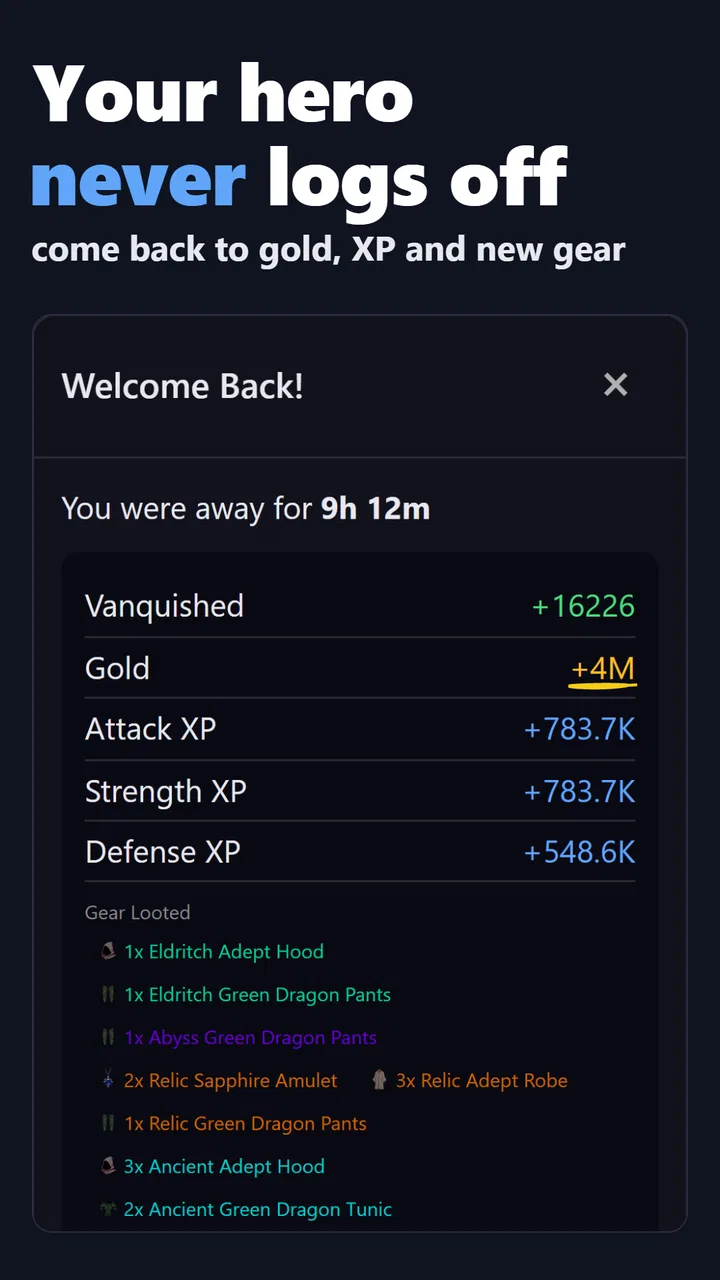
Realm Idle is a focused role-playing game with a clear purpose: improve skills, defeat increasingly stronger monsters, and keep the cycle moving with sensible choices. I liked it most when I treated it as a quiet progression tool rather than a full-scale RPG. Its strongest moments came from recognizing that a modest upgrade had finally made a tougher creature practical.
The game is not rich in variety, and its slow, repetitive structure will be a genuine barrier for some players. I also found that it asks for patience when I wanted immediate evidence that a decision had paid off. Still, the loop is easy to understand, the free entry point makes experimentation simple, and the skilling focus gives the waiting a little more direction than a purely automatic reward track.
My honest recommendation is to try it if you enjoy steady progress and planned check-ins, not if you are searching for constant action. The developer, AbyA, has shaped this into a compact idle RPG where good habits matter more than frantic input. If that sounds like the kind of game you would enjoy opening between everyday tasks, it is worth giving Realm Idle a fair trial. If you need story, spectacle, or hands-on combat to stay interested, choosing a more active alternative will be the better decision.
FAQs for Realm Idle
01What is the main objective of Realm Idle?
Realm Idle is a strategic idle game where players focus on building and expanding their kingdom. The main objective is to manage resources efficiently, upgrade structures, and recruit heroes to protect and grow your realm. As an idle game, progress continues even when you're not actively playing.
02Are there in-app purchases in Realm Idle?
Yes, Realm Idle offers in-app purchases. Players can buy premium currency and various packs to speed up progress, acquire rare items, or enhance gameplay. While purchases are optional, they can provide significant advantages, especially for players looking to advance more quickly through the game.
03Is an internet connection required to play Realm Idle?
Realm Idle requires an internet connection for certain features such as leaderboards, events, and updates. However, the core gameplay can be enjoyed offline, allowing players to continue managing their realm without constant connectivity. This makes it ideal for both active and casual play.
04How does the idle mechanic work in Realm Idle?
The idle mechanic in Realm Idle allows players to accumulate resources and progress even when not actively playing. Structures and heroes continue to function, gathering gold and materials to help upgrade your kingdom. This feature ensures that players are rewarded for their strategic planning over time.
05Can I play Realm Idle on multiple devices?
Yes, Realm Idle supports cross-device play. By linking your game account through a social media login or email, you can sync your progress across multiple devices. This feature provides flexibility, allowing you to manage your kingdom from both Android and iOS devices seamlessly.
Pros
- Intuitive and easy-to-navigate interface.
- Engaging gameplay with strategic depth.
- Frequent updates with new content.
- Low system requirements for smooth play.
- Offline mode available for uninterrupted play.
Cons
- In-app purchases can be pricey.
- Occasional network lag issues.
- Limited character customization.
- Some repetitive tasks in late game.
- Ads can be intrusive at times.

Realm Idle
Gallery